
Imagine you are suddenly forced to flee from your home. As you’re rushing out the door, only able to grab and transport a few personal belongings, what would you choose to bring with you?
As the co-author of a recently published book, NC State College of Education Professor of Adult Education Chad Hoggan explored this question with more than 40 refugees displaced as a result of the Russian invasion of Ukraine, with their rescued belongings serving as a point of entry for them to share their stories.
Teaching the Human Side of Migration: Stories of Flight and Arrival, which is published in three languages—Ukrainian, German and English—uses photos and interviews to share the stories of 41 women who were displaced either within Ukraine or to Germany, and invites readers to imagine what life was like for these women as they made the difficult decision to leave their homes.
Over the course of interviews, these women were asked to identify items they took from their home when they fled, or something they acquired after settling into their new homes, and talk about that object’s significance.


For example, one woman highlighted in the book shared a cup she brought from her home in Ukraine and, in discussing the object, spoke about how the kitchen in her home in Mariupol had been destroyed, how her morning rituals have now changed and the ways in which she is attempting to build a new future for herself.
A second woman featured in the book shared a piece of cloth taken from her daughter’s school uniform, reflecting on how her child’s education was interrupted and how she must now find a new place in a foreign school. Another woman shared photographs of her parents’ graves in Ukraine and spoke of the ways in which her grief for them is complicated by the fact that she can no longer visit the place where they are buried.
By having the interviews center on these personal objects, Hoggan said, the women were able to discuss their experiences of displacement while having narrative control over how their stories unfolded as well as a buffer that allowed them to engage indirectly with their painful experiences.
“The conversations, proceeding through the object, became nuanced narrations of loss and continuity, disruption and adaptation, grief and agency,” he said. “The object made it possible to speak of what was most difficult without being overwhelmed by it.”
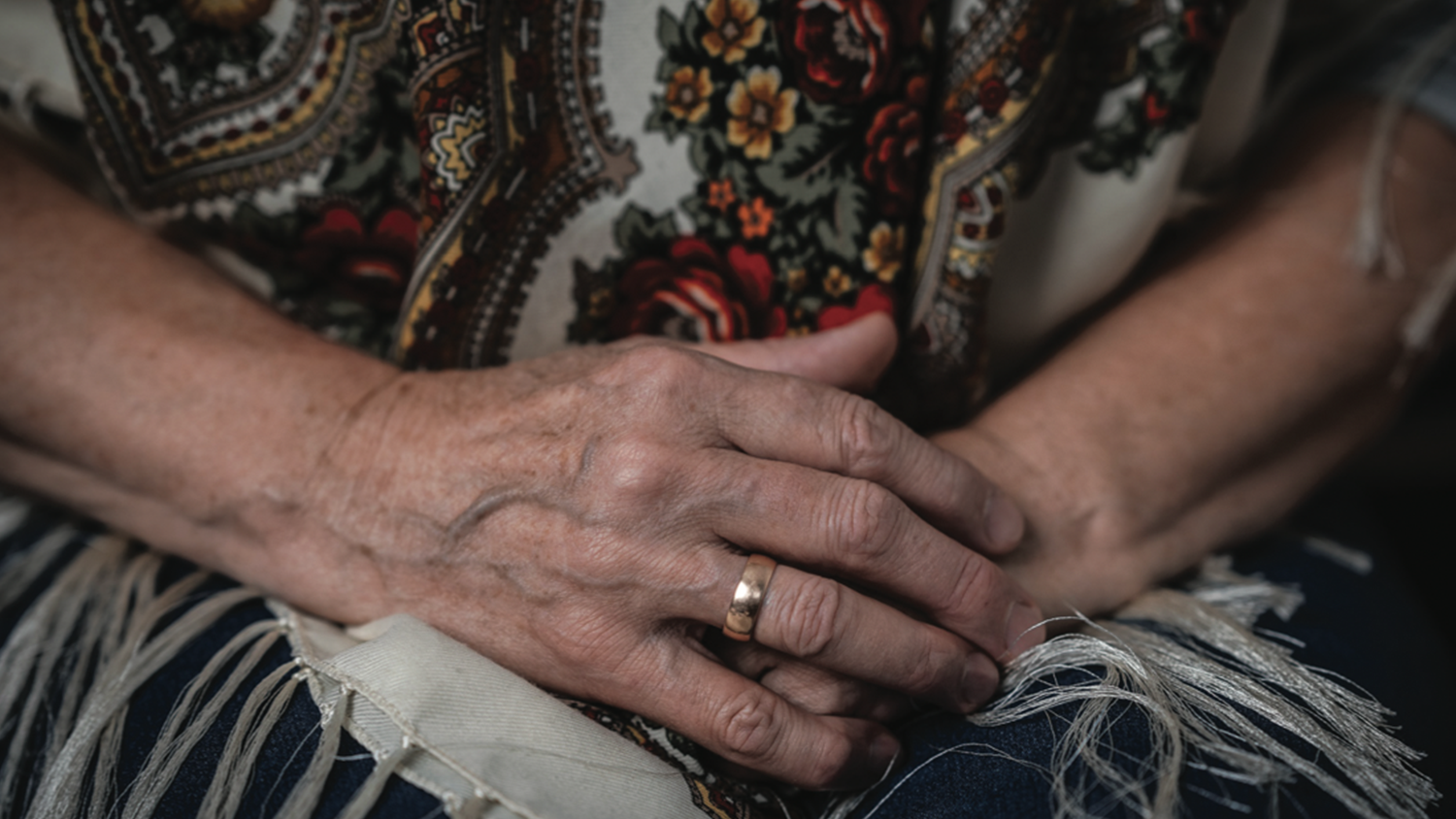
While some women interviewed for the book were photographed with their chosen objects, others elected to have only the object itself photographed.
“These photographic choices also carried meaning. They centered the object’s significance while keeping the woman herself less visibly exposed,” Hoggan said.

In all cases, the women had creative control about not only what was photographed, but the location, framing and other design choices. It was important to the research team, Hoggan said, that the women were not “used” for research, but had the ability to craft their own stories as much as possible.
In addition to being included in the book, these photos, as well as written narratives contributed by the women, became the basis for a public exhibition that ran for six months in a central museum in Augsburg, Germany, where much of the research occurred, and has since been shown in museums across Germany and Ukraine..
Presented in Ukrainian, German and English, the exhibit features posters focused on 10 individual participants and includes glass display cases featuring select objects from the interviews as well as a video loop showcasing segments of the interviews conducted for the book.
“This decision to move the research beyond academic dissemination and into public cultural space carried special significance,” Hoggan said. “It meant that the women’s experiences were not simply ‘data’ to be analyzed in academic articles. They were stories and images to be seen, contemplated and discussed in their community.”
- Categories:


